
There is no payment problem for Russian crude, Petroleum and Natural Gas Minister Hardeep Singh Puri said on Wednesday. He said there is no proposal to cut retail fuel prices at the moment. Addressing a press conference, the minister said India enjoys a buyers' position and foreign suppliers are approaching Indian companies with offers to sell oil.

The oil crisis could not have come at a worse time for the Modi government as its tax collection has fallen short of its 2020-2021 target by Rs 5.2 lakh crore.

Global investors are fast losing appetite for equities, as deflation seems more of a reality. With commodity prices collapsing, few safe havens are left for investors, with many of the BRICS(Brazil, Russia, India, China and South Africa) losing their charm.

The Modi administration has been unable to initiate key reforms.

Economic activity has regained momentum from late-May after the dent caused by the second wave of COVID-19, and the pandemic's impact on the overall asset quality has been less than expected, Reserve Bank Governor Shaktikanta Das said on Thursday. However, Das flagged rising data breaches and cyber-attacks as among the risks for the recovering economy, along with others like firming global commodity prices. The governor also said the second wave had a "grievous toll" on the country.

Hero MotoCorp, a major player in the two-wheeler market, has seen a 9 per cent rise in its stock since the beginning of the month. This increase, driven by the largest motorcycle company by volume, is attributed to expectations of a revival in rural sales due to normal monsoons, government measures to boost consumption, recent market share gains, and a large valuation discount compared to peers. In the near term, the company's volume performance and growth trajectory, particularly in rural markets and entry-level segments, are expected to be key drivers.

Multi-asset allocation funds emerged as the most popular option for MFs as they provided the needed flexibility.

'If the third wave of Covid infections is as bad as the second one, the market may get very polarised with a preference for blue-chips with low volatility.'

A downturn in Indian demand could hit global gold prices.

The wholesale price-based inflation shot up to an all-time high of 10.49 per cent in April, on rising prices of crude oil and manufactured items. Also, a low base of April last year contributed to the spike in inflation in April 2021. The WPI inflation was 7.39 per cent in March 2021, and (-) 1.57 per cent in April 2020. This is the fourth straight month of uptick seen in the wholesale price index (WPI)-based inflation.

G-24 grouping comprises 24 developing countries from Asia, Africa and Latin America.

Gold price declined Rs 305 to Rs 56,035 per 10 grams in the national capital on Thursday amid a fall in rates of precious metal in the overseas markets, according to HDFC Securities. The yellow metal had settled at Rs 56,340 per 10 grams in the previous trade. Silver also plummeted Rs 805 to Rs 65,095 per kg.

The global high comes amidst the uncertainties of Brexit, a trade war and slowing growth, with traders increasing their silver bets.

After the Ukraine war, coke prices just soared and most units don't have money left to buy raw material. Customers are not absorbing the price escalation'

FMCG major Britannia Industries' results for the January-March quarter (Q4) of the financial year 2023-24 (FY24) were received enthusiastically by the market with the share going up by 6.7 per cent on Monday to close at Rs 5,061.60 on the BSE. However, analysts said the results were in line with margins, and disappointing in terms of revenue growth. The consolidated net sales (excluding other operating income) rose 3 per cent year-on-year (Y-o-Y) to Rs 4,010 crore in Q4.

Things are looking up for engineering firms and Siemens is likely to be one of the leading beneficiaries. Apart from the generic revival in activity, which is expected to continue through the 2023-24 financial year (FY24), the Budget has a strong infrastructure thrust, which works in Siemens' favour. The company reported a standalone Ebitda (earnings before interest, tax, depreciation and amortisation) of Rs 550 crore (up 66 per cent year-on-year or YoY) in Q1FY23 (Siemens follows the October-September accounting year).

Oil-to-telecom conglomerate Reliance Industries Ltd head Mukesh Ambani continues to be the richest Indian and has now broken into the world's top 10 wealthiest persons in the latest Forbes 2024 Billionaire List. Ambani, 66, is ranked 9th on the list with a wealth of $116 billion, up from $83.4 billion in the 2023 ranking, according to Forbes. Gautam Adani is the second richest Indian and is ranked at No.17 on the global list.

Warning that the new year will be riskier than the previous two in terms of growth, inflation and the perils of monetary policy normalisation on consumption demand in particular, along with other external risks, a Wall Street brokerage has pencilled in an 8.2 per cent GDP growth next fiscal, with more downside risks to the projection. The biggest risk to the projection is a derailed consumption demand that has been the main growth driver in the past many years, said the Bank of America Securities India house economists who still believe that consumption demand will remain the key driver of growth next fiscal as well.

The central government is likely to further consolidate its fiscal deficit by 50 basis points (bps) to 5.9 per cent in FY24 from 6.4 per cent in FY23, according to a recent report released by Goldman Sachs on Tuesday. In the current fiscal year, there is going to be an upside of 0.5 per cent on the receipts side due to higher nominal GDP growth, and higher tax buoyancy because of the formalisation, the report said. The upside to expenditure is mainly going to come from incremental subsidies (0.8 per cent of GDP), in both food and fertilizer, it said. The upcoming pre-election Budget will carry forward the trend of the increased capital expenditure seen in recent years.

Automobile dispatches from factories to dealerships across the country declined 23 per cent in February, as various supply-side challenges, including semiconductor shortage, and rise in vehicle prices due to the implementation of new regulations continued to impact demand scenario, industry body SIAM said on Friday. Wholesales of domestic passenger vehicles, two-wheelers and three-wheelers declined 23 per cent to 13,28,027 units last month, compared with 17,35,909 units in February 2021. Overall, passenger vehicle dispatches in February 2022 declined six per cent to 262,984 units, compared with 281,380 units in the same month of last year.

Recommends delisting of chana futures, open to lowering sugar import duty

Already retail inflation has risen to 6.07 per cent in February, crossing the upper band of the Parliamentary mandate. This is the second consecutive month in 2022 when retail inflation has crossed the 6 per cent mark having hit 6.01 per cent in January.

Kotak Bank was the top loser in the Sensex pack, shedding 3 per cent, followed by HDFC, Bajaj Finance, Bajaj Finserv, Tech Mahindra, HUL and Titan. NSE Nifty slumped 91.60 points to 14,850.75.

The finance ministry on Thursday raised concerns over the possible impact of El Nio conditions on India this year, saying if recent forecasts came true, the country could see lower agricultural output and higher inflation. "Some meteorological agencies predict the return of El Nio conditions in India this year. "If these predictions are accurate, then monsoon rains could be deficient, leading to lower agricultural output and higher prices," the ministry said in its monthly economic review.

Every 10 per cent rise in crude oil price will shave off around 0.2 percentage point (pp) from India's GDP growth and widen the current account by 0.3 per cent, says Nomura.

If economic growth does not accelerate soon, lower profits and the expectations that accompany them will further deter private investment.

The government on September 14 further reduced the stock limit on wheat traders, wholesalers and big chain retailers to 2,000 tonnes from 3,000 tonnes with immediate effect to control wheat prices, which are showing an uptick again after being stable for some time. Announcing the move, food secretary Sanjeev Chopra said that retail prices of key essential food items, especially wheat, rice, sugar, and edible oils, were unlikely to see any sharp rise in the upcoming festival season as the country had adequate supply and the government was keeping a close vigil on hoarders.
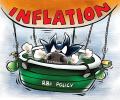
Reserve Bank on Wednesday said it expects retail inflation at 5.2 per cent in the first half of the current fiscal and revised downwards the target to 5 per cent for the quarter ended March. While headline inflation at 5 per cent in Feb 2021 remains within the tolerance band, some underline constituents are testing the upper tolerance level. Going forward, the food inflation trajectory will critically depend on the temporal and special progress of southwest monsoon in the 2021 season, RBI Governor Shaktikanta Das said on Wednesday while announcing the first monetary policy for the current fiscal. Reserve Bank of India (RBI) has kept the key repo rate unchanged at 4 per cent to support growth in the current situation.

Investors have scaled back their allocation to equities as pessimism has reached "dire" levels due to cloudy economic outlook, according to the latest Bank of America (BofA) monthly global fund manager survey that covered nearly 300 money managers with combined assets of $800 billion. The survey showed that the expectations for global growth and profits are at all-time lows and cash levels are at highest since the 9/11 attacks. Interest rate hikes by central banks, the unwinding of an easy monetary regime, disruptions in global supply chains, and fears of recession have heightened market volatility since the beginning of the year.

The Reserve Bank's rate-setting panel, Monetary Policy Committee (MPC), began its three-day deliberations on Wednesday amid expectations of a status quo on benchmark rate mainly on account of uncertainty over the impact of the second wave of COVID-19 pandemic. Moreover, the fears of firming inflation may also refrain the MPC from tinkering with the interest rate in its bi-monthly monetary policy outcome to be announced on Friday. The RBI had kept key interest rates unchanged at the last MPC meeting held in April.

Following are the highlights of the Economic Survey 2022-23 tabled in Parliament on Tuesday
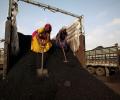
Coal India Limited's (CIL) October-December quarter of financial year 2023-24 (Q3FY24) results have beaten the Street's estimates. Revenue rose 3 per cent year-on-year (Y-o-Y) to Rs 36,200 crore, led by higher volumes and better realisation from Fuel-Supply Agreement (FSA) coal. The blended average selling price (ASP) was down 6 per cent Y-o-Y to Rs 1,727 per tonne, and the FSA ASP was up 3 per cent Y-o-Y to Rs 1,532 per tonne.

Govt unlikely to cut excise duties to compensate for higher global prices, say analysts.

Fast-moving consumer goods (FMCG) companies anticipate sustained volume pressures in the January-March quarter (Q4) coupled with sluggish rural growth during the period. Brokerages estimate top-line growth to be in low single digits in the quarter. Also, the late onset of winter had an impact on demand for winter products which range from moisturisers to hot beverages.

The Opposition members said that despite adequate availability of essential commodities, inflation was still high and government has failed to check the price line. Initiating a debate in the Lok Sabha on rise in prices of essential commodities, Rajiv Ranjan Singh Lalan (Janata Dal-United) said 85 crore (850 million) people in India were below the poverty line and despite this the government was not interested in checking inflation.
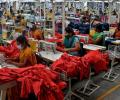
Enthused by higher than expected GDP numbers in the fourth quarter of 2022-23, Chief Economic Adviser (CEA) V Anantha Nageswaran on Wednesday said India's economic growth may exceed the initial estimate of 6.5 per cent in the current fiscal and the country can look for another year of solid economic performance.

"The price cap has been imposed taking into account the sharp increase in prices of raw materials used in making of face masks and hand santiser," Consumer Affairs Minister Ram Vilas Paswan said.

'Overtightening of monetary policy by central banks and the spread of new Covid variants, which may force governments to restart lockdowns or restrict mobility.'
The Reuters-Jefferies CRB index tracks 19 major commodities, including crude oil, gold, silver, copper and aluminum.

The early-bird results for the April-June quarter of 2024 (Q1FY25) hint at a slowdown in corporate revenues and profits in FY25. Corporate profits might face headwinds from a continued revenue growth slowdown and a reversal in margin gains from lower commodity and energy prices in FY24. The combined net profit (adjusted for exceptional gains and losses) of the 210 companies that have declared their Q1FY25 results so far is down 4.2 per cent from the year-ago period - their worst showing in seven quarters.
